Compass
Why you need this: When disasters cut power and cell service, this compass guides you to safety, preventing you from getting lost and protecting your family.Compass: A Practical Guide for Reliable Navigation and Emergency Readiness
A compass is a compact navigation instrument that points toward magnetic north, helping you understand direction anywhere on Earth. While smartphones and vehicle GPS have made navigation feel effortless, a simple, well-made compass remains one of the most dependable tools you can carry. It works without batteries, satellites, or cell signal, and it continues to function in bad weather, power outages, and remote areas. Whether you’re hiking, driving unfamiliar backroads during an evacuation, or working on a large job site, a compass gives you the situational awareness that prevents small mistakes from becoming emergencies.
In everyday life, it’s easy to get turned around in new neighborhoods, dense forests, or sprawling buildings. During emergencies, roads can be closed, landmarks obscured, and electronic devices can fail or give inaccurate readings. A compass helps you orient your map, set a bearing, and confidently move from point A to point B. It’s also invaluable for regrouping if you become separated from your party, for finding safe directions away from hazards like smoke or floodwater, and for keeping you on course when visibility is poor.
Because it’s compact, durable, and simple to use, a compass belongs in your go-bag, glovebox, desk drawer, and hiking kit. With a bit of practice, it becomes second nature to use—and that confidence pays off during stressful moments when clear direction matters most.
How It Works
At its core, a compass uses a magnetized needle that aligns with Earth’s magnetic field. The needle pivots freely on a low-friction bearing, pointing toward magnetic north. A rotating bezel, orienting lines, and direction-of-travel arrow help you translate that magnetic reference into an actual path on the ground.
- Magnetized needle: A slender, magnetized strip balanced on a pivot naturally lines up with Earth’s magnetic field lines.
- Damping fluid or bearings: Many compasses use a liquid-filled capsule to slow needle oscillation for quicker, more stable readings. Others rely on precision bearings.
- Bezel and degree markings: The rotating ring around the capsule shows degrees (0–360) or cardinal points (N, E, S, W) so you can dial in a bearing.
- Orienting arrow and lines: Markings inside the capsule help you align the needle with north while keeping your set bearing steady.
- Baseplate and ruler scales: On map-friendly models, a clear baseplate with rulers and map scales makes it easy to plot routes on paper maps.
- Declination adjustment: Since magnetic north differs from true north, some compasses let you compensate for your local declination so your readings align with map grid north.
By aligning the needle with north and setting your bezel to a chosen degree reading, you can aim your body or your map’s direction-of-travel arrow along the correct route. It’s a simple, robust system that has guided explorers, sailors, and rescue teams for centuries.
When The compass Helps Most
- Natural disasters: During storms, wildfires, floods, hurricanes, or earthquakes, a compass helps you navigate detours, smoke-obscured routes, and damaged infrastructure when GPS is unreliable or maps on your phone won’t load.
- Home and everyday accidents: If you become disoriented at night or in poor visibility—such as fog, heavy rain, or snow—a compass keeps you moving in the right direction to reach a road, trailhead, or meeting point.
- Workplace situations: On large campuses, remote job sites, survey areas, or forestry operations, a compass provides quick bearings, helps teams maintain headings, and supports safety planning and rendezvous points.
- Vehicles and travel: In rural areas with intermittent reception, a compass helps you verify you’re heading in the correct cardinal direction, backtrack along a bearing, or navigate around road closures.
- Outdoor activities: Hiking, backpacking, hunting, fishing, mountaineering, off-trail travel, and orienteering all rely on accurate bearings to avoid getting lost.
- Low-visibility navigation: A compass remains readable in rain, snow, and darkness—especially if there are luminous markings—so you can maintain a course when landmarks vanish.
- Emergency regrouping: If you’re separated from your group, a prearranged bearing to a safety point helps everyone converge reliably.
Strengths, Suitability & Limitations
Strengths
- Battery-free reliability: Works without power, signal, or network access.
- Fast orientation: Quickly confirms direction and helps align maps.
- Precision: Bearing accuracy improves route-finding and reduces backtracking.
- Durability: Quality compasses withstand harsh weather and temperature swings.
- Lightweight and compact: Easy to carry in a pocket, pack, or vehicle.
- Training-friendly: Great for teaching navigation skills and building confidence.
What It’s Not For
- Close to metal or electronics: Steel structures, vehicles, tools, or strong magnets can skew readings.
- Underwater or extreme environments without proper design: Use only purpose-built models for specialized conditions.
- Substitute for planning: A compass doesn’t replace a map, local knowledge, or hazard awareness.
- Precision surveying: Professional surveying requires specialized instruments; a general-purpose compass is not a replacement.
Limitations and safety considerations
- Magnetic declination: Differences between magnetic and true north must be accounted for; learn local declination and adjust as needed.
- Interference: Keep your compass away from phones, radios, knives, and vehicle bodies when taking a reading.
- Needle demagnetization: Strong external magnets can reduce accuracy over time.
- Fluid bubbles: Heat and altitude changes can create bubbles in liquid capsules; inspect regularly.
- Visibility: Low-light navigation requires luminous markings or an external light source; never compromise safety just to keep moving.
- Personal medical devices: Keep magnets at a safe distance from sensitive medical implants; when in doubt, maintain extra space.
What to Look For When Buying a compass
Choosing the right compass depends on how and where you plan to use it. Focus on build quality, clarity, and features that simplify real-world navigation. Beware of look-alike products that cut corners on materials or accuracy; a small discrepancy on the dial can become a big error on the ground.
- Accuracy and stability: A steady needle with minimal wobble and clear, precise degree markings is essential.
- Declination adjustment: A tool-free or screw-based declination setting helps align magnetic north to true north for your region.
- Baseplate features (for map use): Transparent baseplate, straight edges, rulers, and common map scales make plotting bearings fast and accurate.
- Sighting options: A sighting mirror or sighting notch improves precision when taking distant bearings and doubles as an emergency signal mirror.
- Damping and bearing quality: Liquid-filled capsules or high-quality pivots allow faster, more stable readings.
- Global needle compatibility: If you travel between hemispheres, a globally balanced needle helps prevent sticking or tilt errors.
- Durability and materials: Look for robust housings, scratch-resistant capsules, and secure bezels that turn smoothly without being loose.
- Temperature range: Check that the compass remains readable and bubble-free across the temperatures you expect to encounter.
- Visibility: High-contrast markings and safe, non-toxic luminous paint improve night or low-light readability.
- Clinometer (optional): Useful for measuring slope angles in mountaineering, avalanche assessment training, and trail planning.
- Ergonomics: Comfortable size, grippy edges, and a reliable lanyard hole reduce the chance of drops or loss.
- Quality control: Consistent needle alignment, secure seals, and smooth bezel action indicate better manufacturing practices.
Warning about imitations: Very low-cost compasses may have poorly magnetized needles, distorted capsules, inaccurate scales, or weak bezels. If a compass feels flimsy, fogs or bubbles quickly, or the needle sticks during gentle tilts, treat it as a red flag.
Placement, Storage & Readiness
For everyday readiness, keep a compass where you’ll need it most, and protect it from conditions that degrade performance. Redundancy is wise: one in your backpack, one in your vehicle, and one at home ensures you always have access.
- Everyday carry and kits: Store a compass in your hiking pack, emergency go-bag, glovebox, and first-aid kit for quick access.
- Keep away from strong magnets: Don’t store near speakers, magnetic clasps, or tool magnets, which can alter needle magnetization.
- Temperature and sunlight: Avoid prolonged heat or direct sun on a liquid-filled capsule to reduce bubble formation.
- Inspection routine: Every month or before trips, check that the bezel turns smoothly, the needle swings freely, and there are no leaks or bubbles.
- Record local declination: Write your local declination on a small note or the back of a map so you don’t forget in the field.
- Lanyard and tether: Use a neck cord or wrist tether to prevent drops, especially near water or steep terrain.
- Map pairing: Store a small regional map with your compass; the combination is far more powerful than either alone.
- Training and drills: Practice a short navigation loop near home before big trips to keep your skills sharp.
How to Use It Properly
- Pause and assess. Stop in a safe spot, note landmarks, and avoid rushing—calm decisions prevent bigger mistakes.
- Check for interference. Step away from vehicles, fences, tools, and electronics. Hold the compass level at chest height.
- Identify your goal. Pick a destination or a waypoint on your map, or choose a safe direction of travel (e.g., toward a road or ridge).
- Confirm declination. Know your local declination from a printed map margin or pre-trip notes. Set it on the compass if adjustable; otherwise, mentally account for it.
- Orient the map. Place the compass on the map and rotate the map until its north aligns with the needle, adjusting for declination.
- Take a bearing from the map. Draw or visualize a line from your position to the target. Rotate the bezel until the orienting lines match the map’s north-south grid.
- Set your course. Lift the compass, keep it level, and rotate your body until the needle lines up with the orienting arrow. The direction-of-travel arrow now points along your bearing.
- Sight and move. Pick a distant feature (tree, rock, ridge notch) exactly along the direction-of-travel arrow. Walk to it, then sight the next feature to maintain accuracy.
- Track distance and time. Use pacing or time checks so you know when you should reach key features. If something doesn’t match expectations, stop and reassess.
- Re-section if uncertain. If lost, take bearings to two or three recognizable landmarks and intersect the lines on your map to pinpoint your location.
- Communicate. Share bearings with your group so everyone uses the same reference and spacing.
- Safety reminders. Never push through dangerous terrain just to stay on a bearing. Adjust your route for hazards, poor visibility, or fatigue. Recheck your declination and ensure the compass is free of magnetic interference before each reading.
Final Summary
A compass is small, affordable, and incredibly powerful in the moments you need it most. It restores your sense of direction when technology fails, visibility drops, or stress is high. With a little practice, you can confidently set bearings, align maps, and make steady progress toward safety—on the trail, the road, or the job site.
Investing in a quality compass, storing it where you can reach it easily, and practicing a few core skills is a smart, preparedness-focused habit. Pair it with a paper map, keep your skills sharp, and you’ll be ready to navigate through everyday mishaps and genuine emergencies alike.
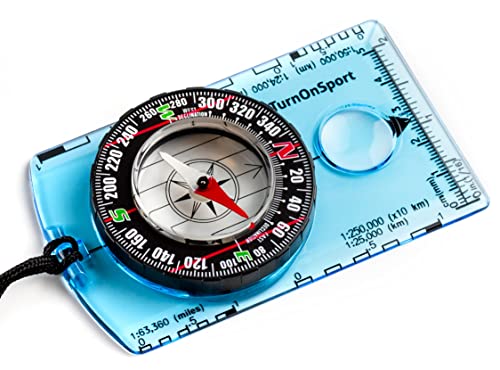
TurnOnSport Orienteering Compass - Advanced Scout Compass for Hiking, Camping, and Backpacking - Best Survival Gifts for Kids Best for most families
- Provides direction from Earth’s magnetic field; no batteries, satellites, or cell service required.
- Sighting mirror enables precise bearings and serves as a daytime signal mirror for rescue.
- Liquid-damped needle and luminous markings support steady, low-light navigation in rough weather.
- Baseplate rulers and declination adjustment speed map-to-ground navigation during evacuations.
 info@emerggear.com