Small Compass
Why you need this: When GPS fails in an emergency, a reliable compass keeps you on course to safety, protecting you and your loved ones.Small Compass Guide: The Pocket Navigation Tool for Everyday and Emergency Use
A small compass is a compact, magnetized navigation instrument designed to point toward magnetic north, helping you maintain direction when GPS reception is weak, batteries die, or visibility drops. In a world that leans heavily on smartphones, having a lightweight, no-batteries backup can make the difference between a minor inconvenience and a major problem.
Whether you are commuting, traveling, hiking, or planning for unexpected events, a small compass offers instant orientation. It can help you choose a safe route, align with landmarks, and move with confidence when stress and confusion make decision-making harder. In emergencies or everyday mishaps, simple tools that always work are invaluable.
Most importantly, a small compass adds reliability and redundancy to your gear. It slips easily into a pocket, first-aid kit, glove box, or keychain pouch, ensuring you can still navigate if your phone breaks, the grid goes down, or weather hides the sun and stars.
How It Works
At its core, a small compass relies on a magnetized needle or disk that pivots freely, aligning itself with Earth’s magnetic field. The needle’s north end settles toward magnetic north while a rotating bezel or printed markings help you read and follow a bearing. Many compact designs include liquid damping to stabilize the needle and luminous markings for low-light readability.
- Magnetized element: A tiny, balanced needle or card rotates to align with Earth’s magnetic field.
- Pivot and damping: A low-friction pivot and often a fluid-filled capsule reduce wobble for quicker, clearer readings.
- Orientation markings: Degree scales, cardinal points (N, E, S, W), and a bezel help you set and follow a direction of travel.
- Baseplate or button styles: Some small compasses include a transparent baseplate with rulers and a direction-of-travel arrow; others are ultra-compact “button” types.
- Global or regional needles: A global needle is engineered to work across hemispheres; basic versions may be tuned for one region.
When The small compass Helps Most
- Natural disasters: During hurricanes, wildfires, earthquakes, or floods, a small compass helps you navigate detours, follow evacuation routes, and move toward predetermined rally points if signage is damaged or visibility is poor.
- Home accidents and disruptions: In extended power outages or after a home incident, it can guide you to nearby shelters, neighbors, or staging areas when phones are dead or maps are unavailable.
- Workplace situations: If you must evacuate a large campus or industrial site, a small compass can help you orient toward exits, muster stations, or safe zones when landmarks are confusing or corridors look similar.
- Vehicles and travel: In a breakdown or when you’ve taken a wrong turn in a remote area, it provides directional clarity to head toward a known road, town, or coast. It can help travelers stay oriented when GPS signals drop in canyons, tunnels, or dense forests.
- Outdoor activities: Hikers, campers, anglers, hunters, paddlers, and trail runners can use a small compass to set bearings, follow handrails like ridgelines or streams, and find camp in fog, snow, or after dark.
Strengths, Suitability & Limitations
Strengths
- Always-on reliability: Works without batteries, apps, or cell service.
- Ultra-portable: Tiny size and low weight make it easy to carry as everyday backup.
- Fast orientation: Provides immediate north reference to steady decision-making in stressful moments.
- Versatile: Useful for commuting, travel, outdoor recreation, and emergency kits.
- Cost-effective redundancy: Inexpensive way to add a critical layer of preparedness.
What It’s Not For
- Not a substitute for skills: A compass works best with basic map-reading and navigation practice.
- Not surveying-grade: Compact designs are not intended for precise land surveying or professional geodesy.
- Not ideal near strong magnets or metal: Heavy machinery, vehicles, and steel structures can distort readings.
- Not guaranteed for underwater or extreme conditions: Unless specifically rated, avoid submersion and severe temperature swings.
Limitations and safety considerations
- Magnetic interference: Keep the compass away from phones, speakers, knives, and vehicle bodies while taking a reading.
- Declination matters: Magnetic north is not the same as true north. Account for local declination for more accurate navigation.
- Quality varies: Low-grade units can have sticky needles, weak magnets, or bubbles that harm accuracy.
- Environmental extremes: Very high or low temperatures can cause bubbles or sluggish needle movement.
- General safety: Use navigation judgment—avoid hazardous terrain, inform someone of your plans, and carry additional essentials like water, light, and a whistle.
What to Look For When Buying a small compass
The right small compass balances accuracy, durability, and readability in a tiny package. Look for design features that deliver reliable performance across everyday and emergency scenarios, and be cautious of toy-grade imitations that look tactical but perform poorly.
- Accuracy and needle performance: Seek a needle that settles quickly without sticking. A global needle is beneficial if you travel between hemispheres.
- Declination support: Adjustable or clearly marked scales help you compensate for magnetic declination in your area.
- Readable markings: Crisp degree increments, a clear north indicator, and a visible direction-of-travel arrow make quick work of bearings.
- Liquid-filled capsule quality: A well-sealed capsule resists bubbles and protects the pivot. Check for clarity and minimal distortion.
- Sturdy materials: Scratch-resistant baseplates, corrosion-resistant metals, and impact-tolerant plastics enhance longevity.
- Bezel action: A smooth, precise bezel with distinct detents or friction that stays put improves accuracy on the move.
- Luminous elements: Non-radioactive, high-visibility markings aid low-light navigation without electronics.
- Size and ergonomics: Balance compactness with legibility. Micro button compasses maximize portability; slightly larger pocket/baseplate types improve accuracy and ease of use.
- Weather resistance: Look for water resistance and a reasonable operating temperature range if you expect harsh conditions.
- Quality control and safety: Prefer products that state compliance with general material-safety guidelines and avoid unknown glow compounds. If intended for kids, ensure no small-part choking hazards.
- Avoid low-quality imitations: Be wary of items with misprinted cardinal points, very weak magnets, or capsules already showing bubbles. Unrealistically low prices and oversold claims are common red flags.
Placement, Storage & Readiness
Proper placement and maintenance ensure your small compass is ready when you need it. Keep one where you can reach it quickly and another staged with your emergency essentials.
- Everyday carry: Pocket, keychain pouch, wallet sleeve, or a small organizer pouch alongside a penlight and bandages.
- Home and vehicle: First-aid kit, emergency drawer, glove box, center console, or seat-back organizer. Pair it with a local paper map.
- Outdoor kits: Daypack hip belt pocket, life-jacket pocket, or top lid of a hiking pack for fast access.
- Away from magnetic clutter: Store away from powerful magnets, speakers, and steel tools to prevent interference or accidental demagnetization.
- Flat and protected: Keep it flat to preserve capsule seals and reduce bubble formation. A small case or pouch prevents scratches.
- Routine inspection: Monthly or before trips, check for bubbles, clear fluid, fast needle swing, and accurate north alignment.
- Pre-staging: Attach a short lanyard, add a mini reference card with local declination, and keep a small map section for your most-used areas.
- Avoid common mistakes: Don’t store it directly on a vehicle dashboard speaker; don’t clip it onto strong magnetic closures; don’t assume it’s accurate without testing.
How to Use It Properly
- Step back from metal: Move a few steps away from vehicles, steel fences, or large electronics to reduce magnetic distortion.
- Hold it level: Keep the compass flat in your palm or on a steady surface so the needle can swing freely.
- Let the needle settle: Wait a moment for the needle to stop wobbling, then identify the north end clearly.
- Account for declination: If your compass has an adjustment, set it. Otherwise, mentally add or subtract the local declination when translating to true north.
- Set a bearing: Rotate the bezel until the desired heading aligns with the direction-of-travel arrow; keep the needle aligned with the orienting arrow.
- Pick a landmark: Choose a visible point—a tree, ridge notch, or building—in line with your bearing to walk to, reducing constant re-checking.
- Walk and verify: Move toward the landmark, periodically stopping to re-level the compass and confirm the needle still matches your bezel alignment.
- Reassess often: If the terrain forces detours, reset your bearing. In low visibility, shorten your landmark intervals.
- Stay safe: Avoid hazardous terrain, keep situational awareness, and let someone know your plan and timeline whenever possible.
Final Summary
A small compass is one of the most reliable, affordable, and portable tools you can add to your everyday carry and emergency kits. It delivers immediate directional awareness when technology fails or conditions turn stressful, helping you make smarter, safer decisions.
Choose a model with clear markings, solid build quality, and dependable needle action. Store it where you can reach it quickly, check it periodically, and practice a few basic techniques. With a small compass in your pack, pocket, or vehicle, you gain a quiet but powerful advantage: dependable navigation wherever life takes you.
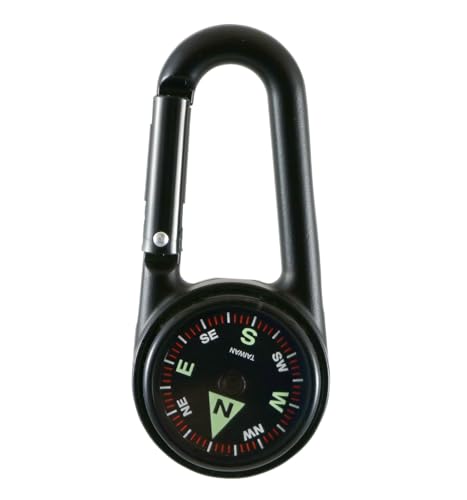
Coghlan’s Outdoor Compasses – Lightweight, Durable Navigation Tools for Hiking, Camping, Orienteering & Survival with Map, Wrist, Lensatic, LED, and Carabiner Options Best for most families
- Works without power; reliable when phones die or networks collapse.
- Provides a constant north reference using Earth's magnetic field.
- Pocket-sized, so it stays with you during evacuations or rescues.
- Enables essential tasks: hold a bearing, orient a map, and retrace steps.
 info@emerggear.com