How Faraday Bags Shield Electronics from EMP During Disasters
Why you need this: During disasters, Faraday bags keep devices untrackable and help prevent fire or water damage, preserving communications, privacy, and your family’s safety.When disasters strike, electricity and communications often fail first. In the case of a nuclear detonation, the initial blast can be accompanied by a high-altitude electromagnetic pulse (EMP) capable of disabling unprotected electronics across a wide region. Solar storms, severe lightning, and even localized power anomalies can produce similar effects on a smaller scale. A Faraday bag—like a high-quality faraday_bag_for_electronics—offers a simple, portable way to shield essential devices so you preserve communication, navigation, and radiation detection capability when it matters most. Here’s how the science works, what to look for in a bag, and how to use one effectively for disaster preparedness, especially in nuclear radiation emergency scenarios.
What Is an EMP—and Why It Matters in Nuclear Disasters
Key takeaway: Nuclear detonations can generate fast, intense electromagnetic fields that induce damaging voltages in electronics. Faraday bags interrupt this pathway.
An electromagnetic pulse is a burst of electromagnetic energy that can couple into conductive paths—wires, antennas, traces, or even device housings—creating sudden voltage and current spikes. In a nuclear context, a high-altitude EMP (HEMP) is often described in three components. E1 is the ultra-fast, high-frequency spike (nanoseconds to microseconds) with electric fields capable of reaching tens of kilovolts per meter. This is the part most likely to overstress microchips and solid-state components inside portable electronics. E2 resembles lightning in duration and character; most surge protectors that work for lightning help here, but they offer no defense against the ultra-fast E1. E3 is slower (seconds to minutes), acting like a severe geomagnetic storm that drives currents in long conductors such as power lines. While E3 primarily impacts grid infrastructure and long cables, small devices can still be vulnerable if they’re connected to extended wiring or antennas.
During a nuclear disaster, the EMP often precedes the arrival of fallout. If your radio, Geiger counter, satellite messenger, or solar charger fails in the first milliseconds of the event, it may be impossible to regain situational awareness or coordinate help. Shielding essential electronics in a Faraday bag minimizes induced voltages by enclosing devices in a conductive barrier, disrupting field coupling at the moment of exposure.
- EMP has multiple components; E1 is the fastest and most damaging to small electronics.
- Induced voltages occur when fields couple into conductive paths—Faraday bags break that pathway.
- Protection is most critical for mission-essential devices used immediately after a nuclear event.
How Faraday Bags Block Energy: The Physics in Plain Language
Key takeaway: A Faraday enclosure channels electromagnetic energy around your device rather than through it, reducing internal fields by orders of magnitude.
A Faraday bag operates on the same principle as a Faraday cage: a conductive shell that redistributes electromagnetic fields. When an external field hits the bag, charges in the conductive layers move, producing opposing fields that cancel most of the energy entering the interior. For fast pulses, the skin effect confines currents to the outer layer (or layers), keeping the inside quiet. Engineers describe effectiveness in decibels (dB) of attenuation. An 80 dB bag reduces field strength inside by a factor of 10,000; in power terms, that’s a reduction of 100,000,000 times. Because EMP energy spans a wide range of frequencies, bags often use multiple layers and dielectric spacing to maintain high attenuation from roughly 1 MHz to several GHz, covering both the fast EMP components and common radio bands.
Seams and closures matter. A small slot or an unsealed fold can behave like an antenna aperture. That’s why reputable designs use overlapping material, magnetic or hook-and-loop closures with conductive interfaces, and multiple folds to minimize leakage. Floating (non-grounded) bags are usually recommended for handheld electronics; the small physical size means the E3 component is less likely to induce significant currents, while the bag keeps E1 out.
- Shielding effectiveness is measured in dB—higher is better across a broad frequency range.
- Layering and tight seams prevent leaks that could let damaging fields into the bag.
- A properly closed bag attenuates both EMP frequencies and everyday RF signals.
Materials and Build Quality: What to Look For
Key takeaway: Not all bags are equal. Choose verified, multi-layer conductive materials, robust seams, and closures designed for tight electrical contact.
Faraday bags typically use metallized films or woven meshes of copper, nickel, or aluminum laminated with protective polymers. Multiple conductive layers separated by thin dielectrics improve attenuation by adding reflection and absorption stages. Look for published, lab-tested performance across key bands (e.g., 1–10 MHz for E1 energy, VHF/UHF for radios and GPS, and 800 MHz–6 GHz for cellular/Wi‑Fi). Independent test methods such as ASTM D4935 (coaxial transmission line) or IEEE 299 (shielding of enclosures) inspire confidence when stated transparently.
Seam construction is critical because gaps compromise the entire system. Durable, conductive seams with ample overlap and a triple-fold closure are superior to simple zip pouches. Abrasion resistance, corrosion protection (particularly for copper and nickel layers), and puncture resistance also matter in rugged field use. In practice, high-quality bags routinely report 70–90 dB attenuation across wide frequencies. If you plan to nest a small bag inside a larger one (or inside a metal container), even better: each layer adds to overall shielding, typically improving total attenuation significantly.
- Seek multi-layer conductive materials with verified, broadband attenuation.
- Poorly sealed seams and closures are the most common failure points.
- Nesting bags or combining a bag with a metal container increases protection.
What to Protect First: Priorities for Nuclear-Radiation Emergencies
Key takeaway: Store devices that preserve communication, navigation, power, and radiation awareness—your decision-making lifelines after an event.
In a nuclear disaster, EMP is a front-loaded threat; fallout and infrastructure disruption follow. Your most valuable electronics are those that help you find accurate information, coordinate with others, and measure radiation. Good candidates include: a handheld AM/FM/NOAA radio or a ham handheld transceiver with spare antenna; radiation meters (Geiger counters, dosimeters); a GPS unit or a smartphone loaded with offline maps and critical documents; a satellite messenger or personal locator beacon; small solar charge controllers and spare USB charge adapters; LED headlamps with spare drivers or simple backup lights; and solid-state storage with copies of ID, medical information, and maps. Keep in mind that simple, non-microprocessor devices (like basic incandescent flashlights) are less vulnerable; prioritize microelectronics first.
Radiation itself (gamma, beta, neutron) is a separate hazard from EMP; a Faraday bag doesn’t shield radiation exposure. Its role is to ensure your electronics survive the initial electromagnetic insult so you can measure and respond to radiation afterward. That ability—to access weather alerts, communicate with responders, or check dose rates—can guide time, distance, and shielding decisions that reduce exposure and risk.
- Focus on radios, radiation meters, navigation tools, and power accessories.
- Store digital copies of documents and critical info on protected drives.
- After EMP, these tools support safe movement and informed choices during fallout.
Practical Tips: How to Use a faraday_bag_for_electronics
1) Inventory and prioritize. Decide which items are mission-critical and dedicate a bag to them. Keep a written contents list on paper outside the bag.
2) Power down and isolate. Turn devices off. Remove external cables and antennas if possible. For lithium batteries, consider storing spares separately in approved containers to reduce fire risk, but keep enough power available to deploy quickly.
3) Prevent conductive bridging. Wrap each device in a non-conductive sleeve (paper or thin foam) before inserting it. This prevents the device from touching the bag’s conductive layer and minimizes the chance of abrasion.
4) Close it right. Follow the closure instructions precisely: press the closure fully, expel air if advised, and make at least two to three tight folds. The goal is to eliminate gaps and maintain continuous conductive contact along the seam.
5) Nest for extra safety. For highest protection, place the closed bag into a second Faraday bag or into a metal container (like a gasketed ammo can). Ensure the inner bag doesn’t touch the outer metal directly—use cardboard or foam spacers.
6) Store dry and cool. Include desiccant packs to control moisture, and inspect the bag periodically for punctures or worn seams. Replace at the first sign of damage.
7) Function test periodically. Without breaking the seal too often, schedule quarterly checks to ensure devices power up, then reseal carefully. For a basic check of RF attenuation, place a powered phone inside, seal fully, and confirm loss of signal—but remember this is a crude test and not a guarantee of EMP performance.
8) Keep a deployment plan. Practice removing gear quickly and re-sealing if you must move. During heightened alerts, keep the bag nearby and pre-packed.
Evidence and Common Myths
Key takeaway: Lab-verified attenuation and good technique matter more than improvised containers or single-point tests.
Myth 1: “If my phone loses bars inside, it’s EMP-proof.” Reality: Cell signals occupy specific bands and power levels; blocking them doesn’t guarantee the broadband, high-level attenuation needed for fast EMP components. It’s a useful quick check, but not definitive. Myth 2: “Grounding is required.” For small bags and handheld devices, floating enclosures typically offer excellent EMP protection. Grounding poorly can create longer conductive paths that reintroduce risk. Myth 3: “Any metal box is fine.” Even a sturdy metal box can leak significantly through seams and lids. Gaskets, overlapping interfaces, and additional internal bagging improve results dramatically. Myth 4: “Aluminum foil alone is enough.” Thin foil can help but is prone to tearing and seam leakage; purpose-built bags are more robust and consistent under stress.
- Use products with published, broadband attenuation data, not just marketing claims.
- Technique—especially seam closure and nesting—often determines real-world performance.
- Redundancy counts: one protected radio is good; two, stored separately, is better.
Quick Skim Summary
- EMP from nuclear events can disable unprotected electronics instantly; Faraday bags reduce internal fields by orders of magnitude.
- Look for multi-layer construction, verified attenuation (around 70–90 dB across broad bands), and strong seam closures.
- Protect radios, radiation meters, navigation tools, power controllers, and critical data storage first.
- Follow best practices: isolate devices, triple-fold seams, nest layers, and store dry with desiccants.
- Use quick tests as a sanity check but rely on certified performance and proper technique.
Conclusion: Why a Faraday Bag Belongs in Nuclear-Preparedness Kits
In emergency and disaster survival planning—especially for nuclear scenarios—preserving electronics is about preserving options. A well-built faraday_bag_for_electronics safeguards the tools that help you understand radiation levels, receive weather and evacuation alerts, navigate changing conditions, and coordinate with family or responders when infrastructure is down. Because EMP risk peaks at the very beginning of a nuclear event, protection must be in place before it happens. By choosing a bag with verified performance, storing the right gear, and using sound technique (folds, nesting, and regular maintenance), you turn fragile electronics into reliable assets. As part of a layered preparedness strategy that also includes radiation awareness, sheltering, and medical supplies, a Faraday bag is a compact, science-backed upgrade that keeps your critical technology ready when you need it most.
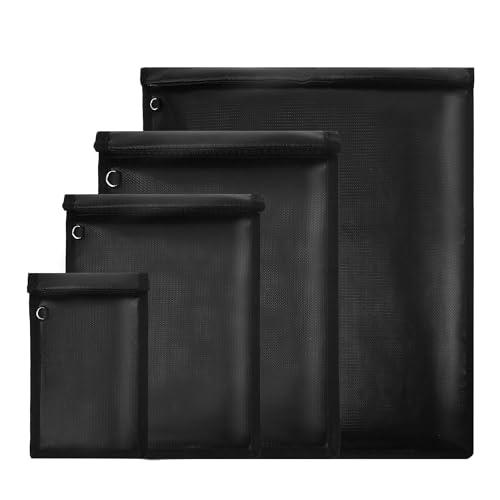
Faraday Bag 4 Pack – Waterproof & Fireproof Signal Blocking Pouch for Laptop, Tablet, Phone, Car Key – Anti-Theft & Anti-Tracking Faraday Cage Sleeve Best for most families
- Blocks cellular, GPS, Wi‑Fi, and Bluetooth to prevent tracking and remote access.
- Attenuates RF energy and electromagnetic surges from EMP or solar storms.
- Prevents remote wipes, malware beacons, and unauthorized access during crises.
- Passive protection that works without power when networks and grids fail.
 info@emerggear.com