How Geiger Counter Radiation Detectors Guide Life‑Saving Emergency Response
Why you need this: You need a radiation detector to know where it's safe, avoid contaminated areas, and protect loved ones during nuclear emergencies or fallout.Why Geiger Counters Matter When Minutes Count
Radiation is invisible, odorless, and fast moving when weather carries it across neighborhoods. In an emergency—whether a nuclear plant incident, a dirty bomb, or an unexpected medical source spill—the first question is simple: Is it safe to be here, and for how long? A Geiger counter radiation detector turns that unknown into numbers anyone can understand in seconds. With a battery, a sensor, and a click, it gives dose‑rate snapshots that guide time, distance, and shielding. The following guide explains the science and practical use for responders and prepared households.
What a Geiger Counter Measures—and How That Saves Lives
Key takeaway: Geiger counters convert ionizing radiation into countable electrical pulses, giving immediate dose‑rate feedback that supports triage and protective decisions.
Inside a Geiger‑Müller tube, a noble gas sits at high voltage. When a gamma ray or energetic beta particle ionizes that gas, a brief avalanche of electrons creates a pulse—your familiar click. The instrument tallies pulses as counts per minute (CPM) and, in energy‑compensated models, estimates dose rate in microsieverts per hour (µSv/h). Most general‑purpose tubes readily detect gamma and high‑energy beta; alpha requires a thin window probe held very close.
Why this matters in an emergency: rapid, repeatable numbers. Typical background ranges around 0.05–0.20 µSv/h at sea level, varying with altitude and building materials. If your geiger_counter_radiation_detector reads substantially above baseline, responders can escalate from routine monitoring to protective actions, such as moving people upwind, switching to indoor shelter, or setting up decontamination lines.
Summary/Quick Skim:
- Converts invisible radiation into CPM and µSv/h.
- Works fast—readouts stabilize in seconds with proper averaging.
- Gamma and high‑energy beta are most easily detected; alpha needs a windowed probe.
- Compare to your known background to spot anomalies.
- Immediate data enable safer, faster decisions.
Translating Dose Rate to Action: Time, Distance, Shielding
Key takeaway: Dose‑rate measurements inform the classic time–distance–shielding strategy that keeps responders and the public safe.
Radiation risk scales with both intensity and exposure time. A Geiger counter that displays µSv/h helps teams budget time in higher‑reading areas, choose longer tools to increase distance, and add shielding when feasible. The inverse‑square rule is your friend: doubling distance from a small source can quarter the dose rate. In practice, that means a reading of 80 µSv/h one meter away might fall near 20 µSv/h at two meters, buying precious minutes for a lifesaving task.
Equipment positioning also benefits. Placing a command post where background is normal keeps cumulative dose to a minimum; designating “hot,” “warm,” and “cold” zones based on mapped readings prevents contamination from spreading. Even for households, this logic matters. If outside air is contaminated, moving to an interior room away from windows and exterior walls can reduce dose while you await official guidance.
Quick Skim:
- Use dose‑rate numbers to budget time.
- Increase distance; shield when possible.
- Establish zones to control exposure and contamination.
Plume Mapping and Zone Control
Key takeaway: Real‑time surveys define safe perimeters and support protective action decisions without guesswork.
Radiation emergencies evolve with wind, terrain, and source strength. By walking or driving transects while logging readings, teams can draw plume edges, choose evacuation routes that minimize dose, and decide where to stage decontamination. Many agencies pre‑plan thresholds for intensified response; the U.S. EPA’s Protective Action Guides frame public actions around projected doses on the order of tens of millisieverts, with local officials tailoring triggers to context. Your detector contributes the near‑term piece: what the dose rate is here and now.
For personal preparedness, this translates to situational awareness rather than self‑directed evacuation. If readings rise well above your documented baseline and authorities advise sheltering, you can choose the lowest‑reading room and reduce time near higher‑reading areas such as exterior doors. If told to evacuate, monitoring the route can help you avoid hotspots while following official instructions.
Summary:
- Survey to map the plume and set perimeters.
- Detector data feed evidence‑based decisions.
Counts vs Dose: Understanding Your Readout and Its Limits
Key takeaway: Understand what your Geiger counter is—and isn’t—telling you.
Most handheld units with energy‑compensated tubes display dose rate (µSv/h) reasonably for common gamma energies. Pancake probes excel at finding surface contamination via CPM but may over‑ or under‑estimate dose unless calibrated. Alpha particles are easily blocked by air and skin; to detect them you need a thin mica window and must hold the probe within a centimeter of the surface.
Two technical limits matter in emergencies. First, dead time: after each pulse, the tube briefly cannot count another event. Extremely high fields can produce “saturation,” where the readout stops increasing or even falsely drops. Second, energy response: low‑cost tubes respond differently across photon energies, so the dose estimate is approximate. Mitigate both by following the manufacturer’s range limits, watching for erratic behavior at very high readings, and using time‑averaged modes for stability.
Quick Skim:
- Use µSv/h for exposure control; CPM for contamination hunting.
- Alpha detection needs a windowed probe held very close.
- Beware saturation and energy‑response quirks at high fields.
Choosing the Right Geiger Counter for Preparedness
Choosing the right tool depends on your mission. For household preparedness, a compact energy‑compensated Geiger counter, such as the geiger_counter_radiation_detector, provides dependable dose‑rate readings for shelter‑in‑place decisions and route selection. If you anticipate surface checks—for example, screening clothing or packages—consider a model with a detachable pancake probe. For professional response teams, a mix works best: a rugged survey meter for mapping, a contamination probe for smear and body surveys, and a personal electronic dosimeter for cumulative dose tracking.
Look for features that matter in the field: clear µSv/h and CPM displays, audible click and alarm thresholds, long battery life, easy decontamination (sealed seams, wipeable surfaces), and documented calibration. A simple check source or built‑in test helps verify function before deployment. Water‑resistant housings and glove‑friendly buttons are welcome under stress too.
Practical Tips: Using a Geiger Counter in an Emergency
Before an event:
- Establish your baseline. Measure and note typical readings in and around your home.
- Power and spares. Keep fresh batteries and a flashlight with the instrument.
- Practice. Learn how to switch between CPM and µSv/h, change averaging times, and set alarms.
During an alert:
- Follow official instructions first. Use measurements to optimize how you comply, not to self‑deploy.
- Survey methodically. Hold the detector steady for 10–30 seconds per location; avoid waving it quickly. Keep a consistent height for dose‑rate surveys.
- Choose safer spaces. Prefer interior rooms with lower readings; minimize time near exterior walls or open windows if outside levels are elevated.
- Check for contamination. If you have a windowed probe, scan clothing and hands a centimeter away; bag items that read above background.
- Mind geometry and shielding. Note that your body, walls, or vehicles can lower readings—record where you measured.
- Watch for saturation. If numbers are erratic or stick near zero despite alarms clicking rapidly, retreat and reassess.
Afterward:
- Document times, locations, and readings. Photographs of the display near landmarks help.
- Decontaminate. Wipe the instrument with detergent; do not soak. Wash hands and change clothes.
Quick Skim: What to Remember
- Background is typically around 0.05–0.20 µSv/h; know your local baseline.
- Use µSv/h to manage exposure; use CPM to hunt contamination.
- Increase distance, reduce time, add shielding—let the numbers guide you.
- Watch for detector limits in very high fields.
- Follow official instructions; use your readings to improve how you comply.
- Record what you measure and where; experience now sharpens future decisions.
Conclusion: A Small Instrument, Outsized Protection
A Geiger counter radiation detector is a small instrument with outsized impact when the stakes are high. By translating ionizing radiation into clear, immediate numbers, it empowers responders to set zones, route evacuations, and manage dose, and it helps prepared households make safer choices while awaiting official guidance. Combined with fundamentals—time, distance, and shielding—and complementary gear like dosimeters, decontamination supplies, and emergency communications, the humble clicker becomes a cornerstone of nuclear and radiological readiness. Measure, decide, and act with confidence. Train briefly today so critical choices feel familiar tomorrow too.
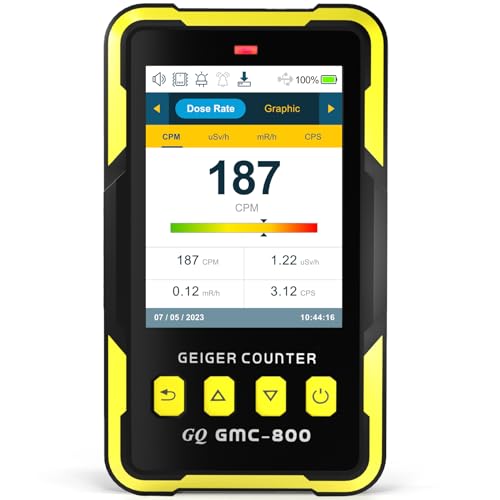
Nuclear Radiation Detector GQ GMC-800 Geiger Counter USA Design Product US National Standard Large Color LCD Display 5 Alarm Types Dosimeter Data Save & Global Share Beta Gamma X-ray Portable Device Best for most families
- Real-time dose rate (µSv/h) and cumulative dose support immediate shelter-in-place or evacuation decisions.
- Audible and visual alarms at set thresholds warn early to limit exposure.
- Locates contamination hotspots and checks shielding effectiveness of walls, vehicles, and improvised barriers.
- Battery-powered, rugged, and independent of cell networks; operable with gloves in low light.
 info@emerggear.com