Why Potassium Iodide Tablets Belong in Nuclear Emergency Kits
Why you need this: You need potassium iodide tablets to protect your family's thyroids in a nuclear emergency, reducing radioactive iodine exposure and lowering cancer risk.Potassium iodide tablets—often abbreviated KI—are a small, inexpensive item that can make an outsized difference in a nuclear emergency. No pill can shield the whole body from radiation, but KI has one job it does exceptionally well: protect the thyroid gland from radioactive iodine. In accidents at nuclear power plants and in some nuclear detonations, iodine-131 can be released into the air and food chain. Without protection, the thyroid concentrates iodine, raising the risk of thyroid injury and cancer, especially in children. This article explains the science of how KI works, when it works best, how to use it safely, and how to integrate it into a practical emergency kit.
1. How Potassium Iodide Protects the Thyroid
Key takeaway: KI saturates the thyroid with stable iodine, blocking uptake of radioactive iodine-131.
Your thyroid needs iodine to make hormones. It is also “greedy”—it pulls iodine from the bloodstream efficiently, and it cannot distinguish between stable iodine (safe) and radioactive iodine-131 (hazardous). KI is simply a salt of non-radioactive iodine. When you take a proper dose at the right time, the thyroid becomes saturated with stable iodine. This triggers the “Wolff–Chaikoff effect,” a temporary feedback mechanism that sharply reduces iodine uptake. The result is far less radioactive iodine entering thyroid tissue, translating to a lower radiation dose and lower risk of later thyroid cancer.
Public health agencies including the World Health Organization (WHO), U.S. Centers for Disease Control and Prevention (CDC), and U.S. Food and Drug Administration (FDA) all recommend KI for protecting the thyroid during specific radioactive iodine exposures. KI’s benefit is most important for infants, children, adolescents, and pregnant or breastfeeding people, whose thyroids are particularly sensitive.
- KI fills the thyroid with safe iodine, reducing radioactive iodine uptake
- Most protective for young people and during pregnancy
- Targets one risk: thyroid exposure to iodine-131
2. Timing, Dose, and the Protection Window
Key takeaway: KI works best when taken shortly before or at the time of exposure, and still confers benefit for a few hours after.
Timing matters. Guidance from WHO and CDC indicates the highest protection occurs when KI is taken just before exposure, or immediately when exposure is expected or begins—ideally within two hours. Protection remains meaningful even if taken up to several hours after exposure, but it steadily declines with time. KI does not help for radionuclides other than iodine; it is not a universal radiation antidote.
Dose depends on age. For most adults, the recommended dose is 130 mg of KI (which provides 100 mg of iodide). Children require lower doses. Public health authorities may advise repeated daily dosing if radioactive iodine exposure persists, with special caution for newborns and pregnant or breastfeeding people to avoid thyroid suppression in the infant. Always follow official instructions during an event.
- Best effect: take KI shortly before or at the start of exposure
- Protection decreases with delay but can still be helpful for hours
- Use age-appropriate dosing; follow official guidance for repeat doses
3. Real-World Evidence from Nuclear Incidents
Key takeaway: Properly timed KI distribution has reduced thyroid radiation doses in past nuclear emergencies.
Evidence from the Chernobyl accident in 1986 and subsequent analyses shows that children’s thyroids were particularly vulnerable to iodine-131 released into air and milk. Countries that rapidly provided KI—such as Poland, which distributed millions of doses to children—reported lower estimated thyroid doses and likely prevented excess thyroid cancers. While many factors influence risk (including evacuation timing and dietary restrictions), KI is consistently cited in expert reviews as a practical, effective measure for reducing thyroid exposure when used promptly.
After Fukushima Daiichi in 2011, authorities relied more on evacuation and food controls, but KI was stockpiled and made available for targeted use. These experiences reinforced a key lesson: KI’s value increases when it is pre-positioned and accompanied by clear public guidance.
- Post-accident analyses support KI’s ability to lower thyroid dose
- Children gain the most benefit
- Pre-distribution and clear instructions improve outcomes
4. Who Should Take KI—and Who Should Be Cautious
Key takeaway: Most people can safely take KI during a radioactive iodine emergency, with special dosing for children and specific cautions for certain medical conditions.
Public health guidance prioritizes the following groups when iodine-131 exposure is likely: newborns, infants, children, adolescents, and pregnant or breastfeeding people. Adults up to age 40 are also commonly included when predicted thyroid doses are meaningful. Adults over 40 are typically advised to take KI only if very high exposures are expected, because their baseline thyroid cancer risk is lower and side effects may be more common.
Use caution if you have a known thyroid disorder (such as multinodular goiter, Graves’ disease, or autoimmune thyroiditis), dermatitis herpetiformis, hypocomplementemic vasculitis, or a history of severe reactions to iodinated contrast or antiseptics. True “iodine allergy” is rare because iodine is essential to life, but people can react to iodinated compounds. In any emergency, defer to official announcements and your healthcare provider when possible.
- Priority: infants, children, adolescents, and pregnant/breastfeeding people
- Adults over 40 usually take KI only if high exposure is anticipated
- Consult medical guidance if you have thyroid disease or prior severe reactions
5. Limits and Myths: What KI Does Not Do
Key takeaway: KI is not a “nuke pill.” It protects only the thyroid from radioactive iodine, not from other radionuclides or external radiation.
KI cannot prevent radiation injury from cesium-137, strontium-90, plutonium, neutrons, or gamma rays. It does not make it safe to stay in a hazardous area, nor does it replace evacuation, sheltering, or control of contaminated food and water. Taking KI when radioactive iodine is not present offers no benefit and can pose unnecessary risks, particularly for infants. Its role is targeted and complementary: it is one tool among many in a layered radiation safety strategy.
- KI protects only against iodine-131 uptake in the thyroid
- It does not shield the whole body from radiation
- Use alongside sheltering, evacuation, and food/water controls
6. Building KI into a Thoughtful Nuclear Emergency Kit
Key takeaway: Pre-positioned KI with clear instructions lets families act quickly when minutes matter.
An effective kit combines the right supplies with a simple plan. Store enough KI for each household member in original, labeled blister packs with dosing instructions. Include a child-appropriate liquid or crushable formulation for those who cannot swallow pills. Keep the kit with your shelter-in-place supplies and your go-bag, and rehearse how you will listen for official alerts and when you will administer KI. Add a notepad to record dosing times and ages, and keep contact details for your local health department.
- Stock adequate KI for every household member, including infants
- Place with your shelter kit and go-bags; rehearse your plan annually
- Keep printed dosing guidance and a way to record times
Practical Tips: How to Use Potassium Iodide Tablets
These steps align with guidance commonly issued by national health authorities during radioactive iodine emergencies. Always follow official instructions during an actual event.
- Wait for instructions. Take KI only if public health officials advise it or if your emergency plan specifies pre-approved triggers (for example, a shelter-in-place alert with expected iodine release).
- Use age-appropriate dosing:
- Adults and adolescents 12–18 years who weigh 70 kg or more: 130 mg KI
- Children 3–18 years who weigh under 70 kg: 65 mg KI
- Children 1 month–3 years: 32 mg KI
- Birth–1 month: 16 mg KI
- Pregnant or breastfeeding adults: 130 mg KI (avoid repeated doses unless specifically instructed)
- How to give it. Swallow tablets with water, or crush/mix with soft food or liquid for infants and young children. Measure carefully when splitting tablets.
- When to repeat. If exposure to radioactive iodine continues, authorities may direct once-daily dosing for a limited period. Infants, pregnant, and breastfeeding people require special caution to avoid thyroid suppression in the baby.
- Watch for side effects. Possible effects include gastrointestinal upset, rash, or transient changes in thyroid function. Seek medical advice for breathing difficulty, swelling, or severe rash. Infants who receive KI should have follow-up thyroid evaluation as advised.
- Storage. Keep KI in a cool, dry place in sealed packaging. Check expiration dates, though potency may remain acceptable beyond labeled expiry in some stockpiles; follow official guidance.
- Coordinate with other protective actions. KI is not a substitute for evacuation, sheltering, closing ventilation, and avoiding contaminated food or milk.
- Do not take KI as a daily supplement or “just in case” absent official guidance
- Pre-measure and label children’s doses to save time during an alert
- Add a small syringe or spoon for mixing infant doses into your kit
7. Why KI Belongs in Every Nuclear Emergency Kit
Key takeaway: KI is low-cost, easy to store, and provides high-value, targeted protection against a well-understood risk.
Emergency planning is about stacking practical layers. KI is one of those layers: compact, affordable, and scientifically validated for a specific hazard pathway—iodine-131 to the thyroid. It pairs perfectly with other essentials, from battery-powered radios and N95 masks for dusty conditions, to water, food, and plastic sheeting for sheltering in place. When a community faces a release of radioactive iodine, having KI on hand can turn confusion into clear action.
- Small, stable, and inexpensive addition to any kit
- Backed by decades of thyroid radiation protection science
- Works best when pre-positioned with instructions
Conclusion: A Smart Addition to Nuclear Emergency and Disaster Gear
Potassium iodide tablets are not a cure-all, and they do not negate the need for evacuation, sheltering, and food safety measures. But in the narrow, critical domain of thyroid protection from radioactive iodine, KI is a proven tool that can meaningfully reduce risk, especially for children. It is compact, shelf-stable, and easy to administer quickly when instructions arrive. For conscious adults preparing thoughtfully for nuclear radiation disasters, KI belongs alongside radios, water, first-aid, and protective masks—ready to translate science into safety when the clock is ticking.
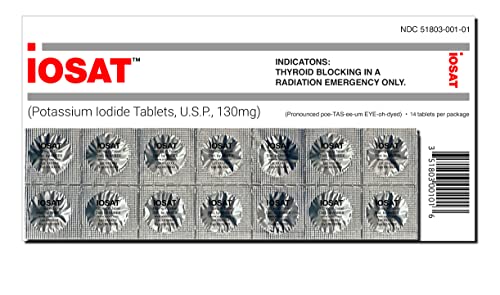
Potassium Iodide Tablets - 14 130mg tablets Best for most families
- Blocks thyroid uptake of radioactive iodine during nuclear incidents.
- Most effective when taken as directed by public health officials.
- FDA-approved for radiation emergencies and stockpiled by emergency agencies.
- Protects only the thyroid; complement with sheltering and decontamination.
 info@emerggear.com